





HIPAA Security Rule update

    The HIPAA compliance platform · since 2010

    HIPAA compliance, handled.

    The only HIPAA platform with the security operations built in: SIEM, dark web monitoring, phishing defense, encrypted email. Audit-ready in 60 days, guaranteed.

    10 minutes · No credit card · No call required

    500+ healthcare organizations, including

    • The Doctors Company
    • Premier
    • MedNetOne Health Solutions
    • Revele
    • Reznicek Dental Group
    • Digirad

    Why programs fail

    The binder says compliant. The evidence says maybe and years ago…

    Most practices that fail an audit thought they were compliant. They were, once. Here is how the requirements fall off the radar for most organizations, one at a time, until they become a big problem.

    Paperwork vs. realityStart

    94/100

    The binder · 8 of 8

    RequirementEvidence
    TrainingAll staff complete
    Licenses & certsAll current · verified on hire
    Exclusion checksMonthly · current
    Risk analysisComplete · documented
    PoliciesReviewed this year
    OfficersNamed · posted to staff
    IncidentsReporting path posted
    Devices & emailRegister current · email encrypted
    1. Start

      Audit-ready.

      Onboarding done, policies signed, staff trained. The binder is perfect, and for now, so is the evidence. Every piece already lives with a different person.

    2. Training

      Training gets checked off.

      The training we took was generic, free, and mostly explained what HIPAA is.

      Training has to cover your own policies, fit each role, and be documented per employee. A generic course does none of that, and an auditor asks for the records, not the certificate.

    3. New hires

      Two new hires.

      Training… some of it got done. I’d have to check.

      Every new hire has to be trained on your policies within a reasonable time of starting, with a dated record. To an auditor, no record means no training.

    4. Encrypted email

      PHI starts leaving in plain text.

      Some of our staff know how to send encrypted email.

      PHI in email has to be protected in transit, for everyone, not only the staff who learned how. Lost encrypted PHI is not a reportable breach. Unencrypted PHI is.

    5. Risk analysis

      The risk assessment becomes a rumor.

      I thought IT did the risk assessment.

      The risk analysis is yours, not IT’s: accurate, thorough, written down, and updated when the practice changes. It is the first document an investigator asks for.

    6. IT documentation

      IT handles it. Nobody can show it.

      Our IT company handles our updates. Documenting what they do is another question.

      Your IT company can do the work, but the record has to be yours: what was patched and when, what was reviewed, and a signed business associate agreement. Kept for six years.

    7. Exclusion checks

      The monthly exclusion check stops.

      We haven’t run exclusion checks in over a year.

      The OIG updates its exclusion list monthly and recommends monthly checks of everyone you employ. Work by anyone on it cannot be billed to Medicare or Medicaid, and past billings come back.

    8. Licenses & certifications

      A license expires. The spreadsheet doesn’t say so.

      Our licenses and certifications are in a spreadsheet HR keeps. I’d have to ask who checks it.

      Every license expires on a date, and past it that person’s work is a problem for every claim it touches. Nobody notices from a spreadsheet. Expirations need an owner and a reminder that fires first.

    9. Officers

      Nobody knows who to call.

      90% of our employees don’t know who the security or privacy officer is.

      Privacy and security officers have to be designated in writing, and staff have to know who they are. An employee who does not know who to call does not call.

    10. Incident reporting

      A suspected incident goes unreported.

      No one really knows how to report a suspected incident. And if someone did, I’m not sure who would do the assessment, or how fast.

      Once one is reported, the clock is running: log it, run the four-factor risk assessment, and either document it as low risk or notify the people affected, all on a deadline that counts from the day it was discovered, not the day someone got around to it.

    11. Policies

      Policies from three years ago.

      What does our Notice of Privacy Practices even say?

      Policies have to be reviewed on a schedule, updated when the practice or the rules change, and acknowledged by staff. Three-year-old policies describe a practice that no longer exists, and the Notice of Privacy Practices is a written promise to patients.

    12. Devices

      A laptop walks out.

      Tracking our assets and security posture is a nightmare. I guess IT handles that.

      Every device that touches PHI belongs on an inventory with an owner and a known encryption status. Whether a lost laptop is a reportable breach comes down to one question: can anyone prove it was encrypted?

    13. The audit

      The audit letter arrives.

      Wasn’t compliance onboarding done?

      It opens with a letter asking for the risk analysis, the policies, the training records, the incident log, the business associate agreements, and proof they were in force on the dates in question. The letter names a deadline.

    14. The scramble

      Everyone has a piece. Nobody has the picture.

      Some of it is in HR, some is in a spreadsheet, IT has some, and the office manager has the rest.

      Assembling proof from five people and four tools in ten business days is a project nobody has time for, and every gap found is a gap to explain. Practices that respond well had the evidence in one place, dated, already.

    15. Then

      Live Compliance steps in.

      Same practice, same people, one system. HR, IT, office managers, officers, and every employee work inside Live Compliance, so the compliance lead sees the whole picture. The binder and the evidence finally say the same thing.

      HIPAA training assigns itself by role. OIG exclusion checks run on hire and every month after. Licenses and policies carry their own reminders, and the risk analysis has an owner. Any employee can report a concern to the designated security officer in one click, and our compliance team guides the four-factor breach risk assessment on time.

      See how it works

    If this is you

    If you run compliance, you probably do have most of this.

    It is in HR, in a spreadsheet, with IT, with the office manager, and in your binder. Nobody did anything wrong, and nobody has the whole picture, because none of those places talk to each other. Live Compliance puts every piece in one system and every person who touches it inside, so you see the whole picture. So does an auditor.

    What we do about it

    Live Compliance keeps it alive.

    Everything that fell off the radar in the story above, back on it. Three ways.

    01 / 03

    Watch.

    The drift is caught while it is still a fix.

    Agents on every workstation, credentials checked against the dark web, staff tested with real phishing, PHI encrypted in transit. Nothing waits for someone to notice.

    Back on the radar

    • Devices & email
    • IT documentation
    • Encrypted email
    Security operations
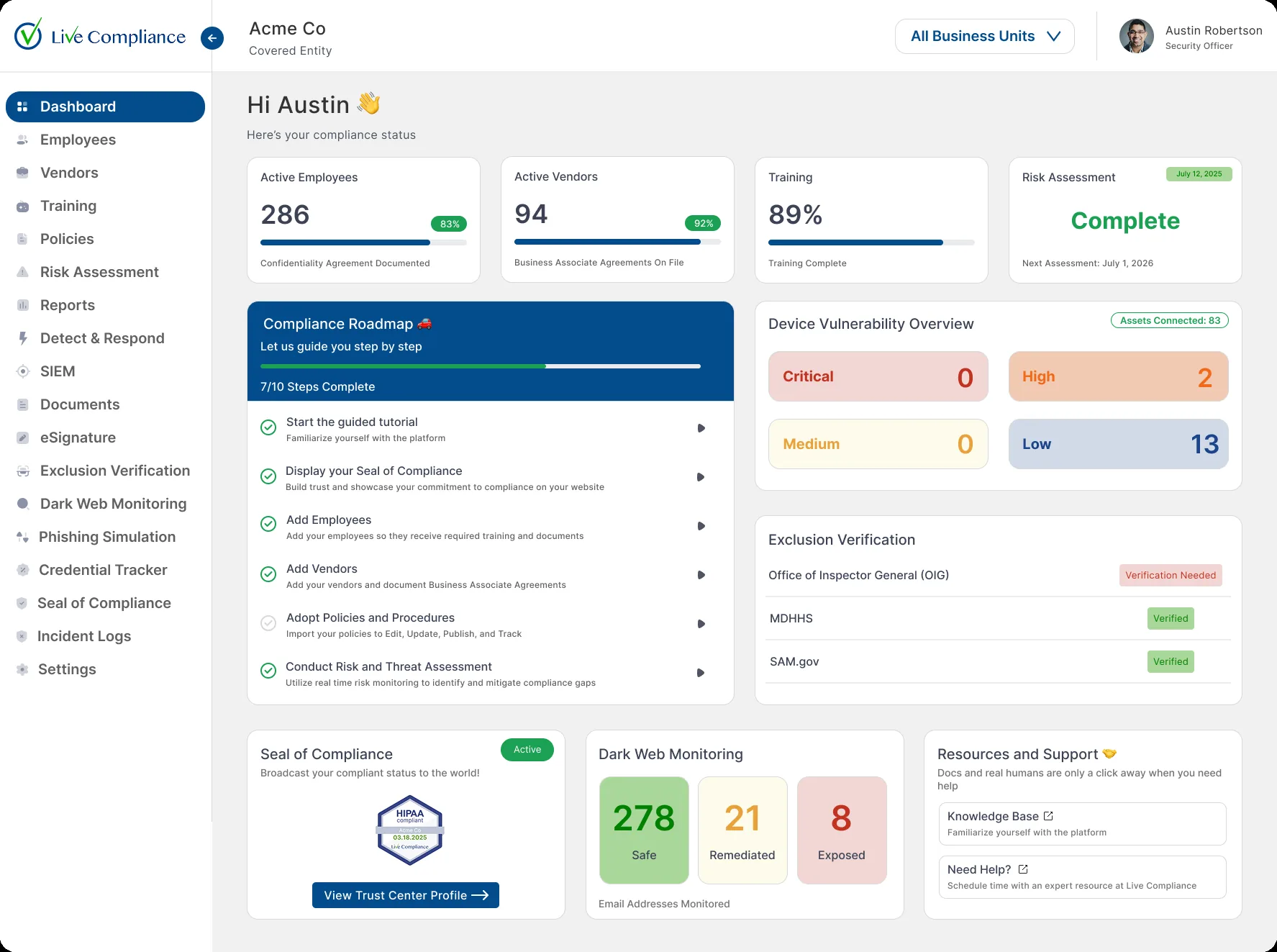
    Security operations screen listing every workstation with its last scan time and a vulnerabilities table with remediation actions.

    Every workstation, scanned around the clock

    02 / 03

    Prove.

    The evidence writes itself.

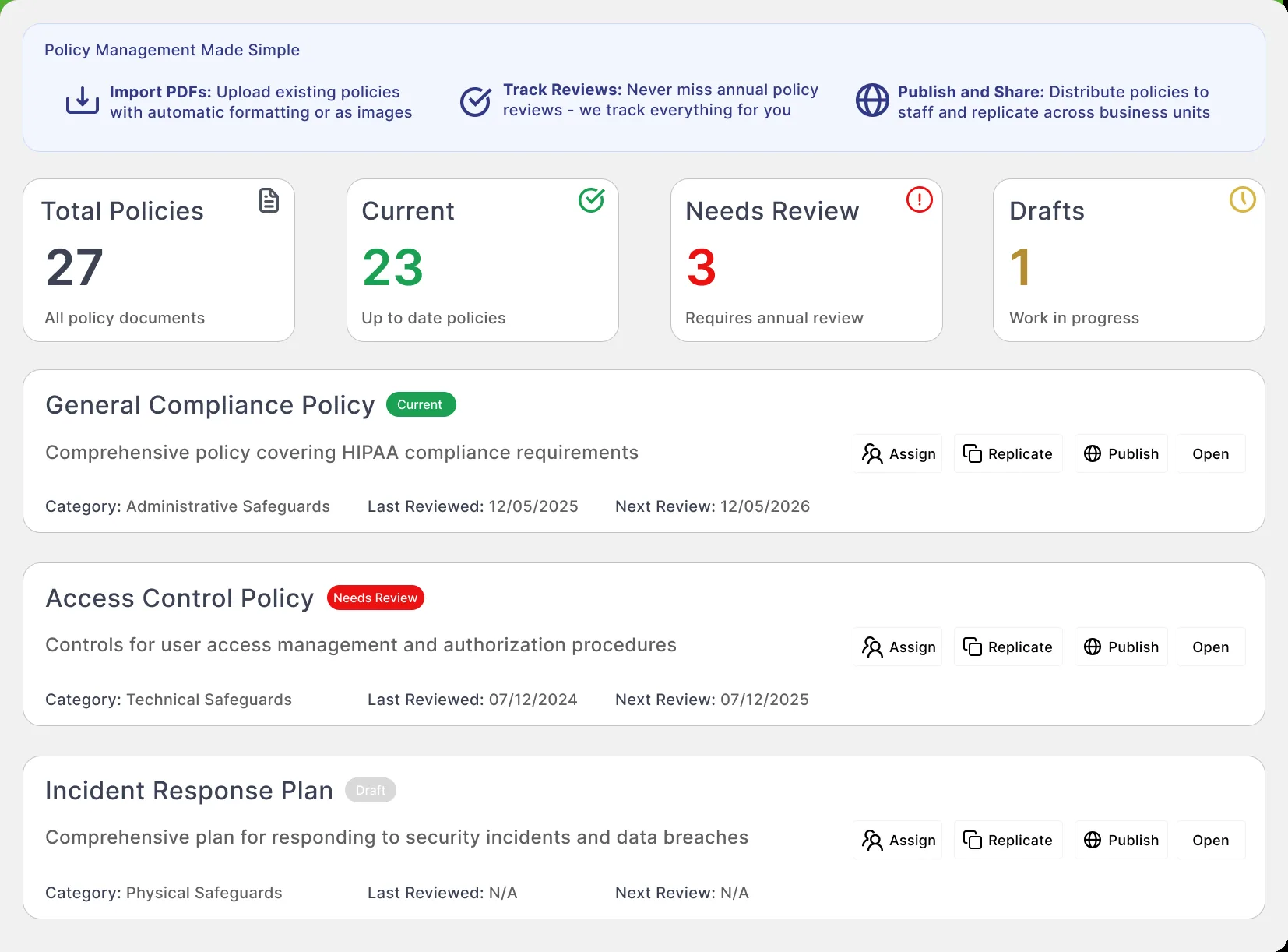
    Every training certificate, license date, exclusion check, policy acknowledgment, and risk analysis is timestamped as it happens. Proof is one export, not one weekend. And the seal on your website shows it, live, to anyone who looks.

    Back on the radar

    • Training
    • Licenses & certs
    • Exclusion checks
    • Policies
    • Risk analysis
    • Public proof
    Inside the platform

    Review dates tracked, reminders sent

    03 / 03

    Own.

    One team owns the outcome.

    A named compliance team runs the program with you, the Staff Portal puts the security officer’s face in front of every employee, and the outcome is guaranteed: audit-ready in 60 days, or we keep working at no additional cost until you are.

    Back on the radar

    • Officers
    • Incident reporting
    • Every stakeholder
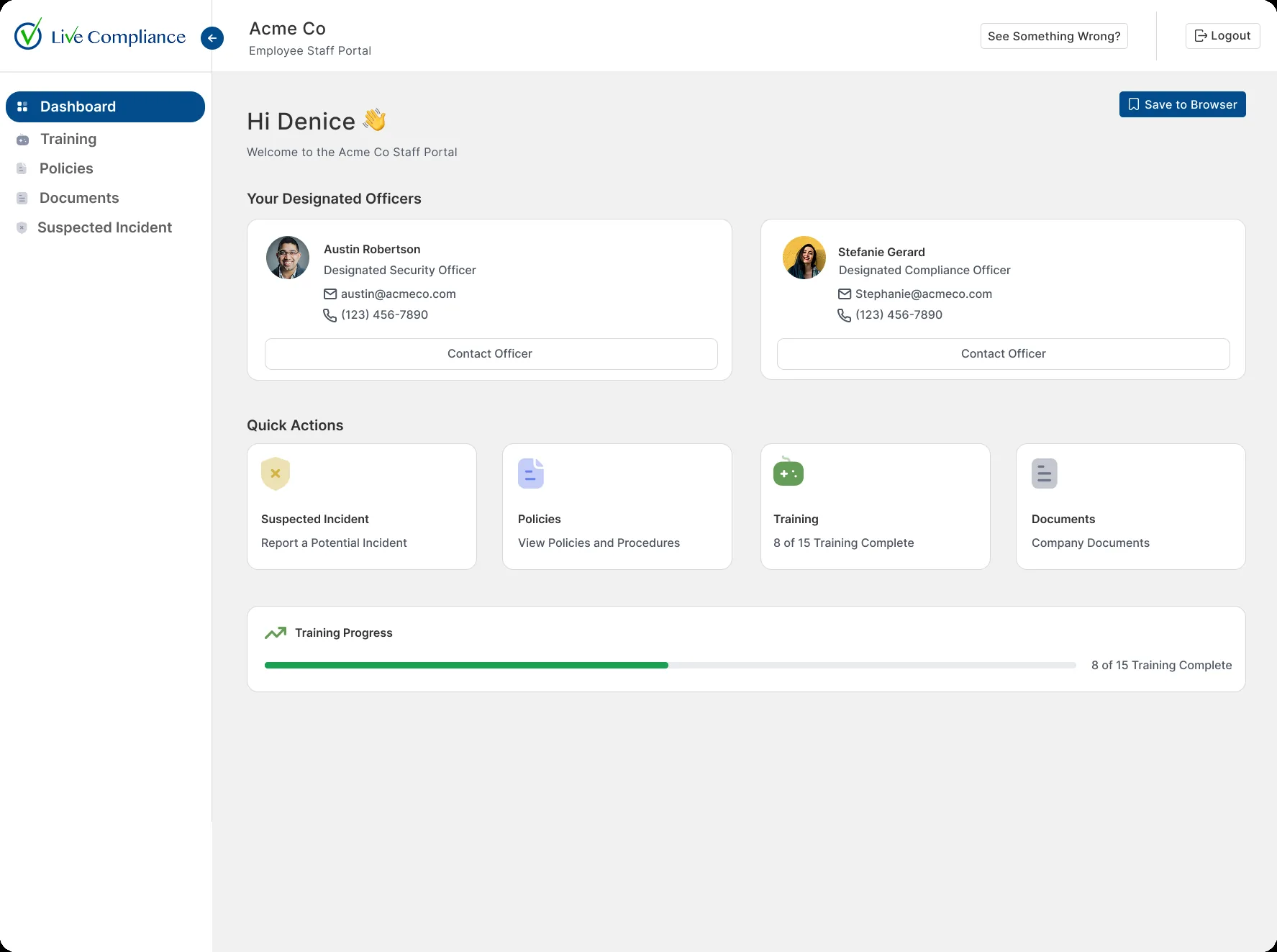
    The Staff Portal
    Staff Portal showing the designated security and compliance officers with photos and contact buttons, and quick actions for reporting an incident.

    Every employee sees this

    Our Guarantee

    Audit-ready in 60 days, or we keep working at no additional cost until you are.

    We have never had a client fail a HIPAA audit. Not in 16 years. Not across 500+ organizations. If you are not audit-ready in 60 days, we stay on it at no additional cost until you are.

    500+

    healthcare organizations

    100%

    audit success rate

    16 yrs

    HIPAA-only specialization

    10 minutes · No credit card · No call required

    How it works

    From where you are to audit-ready.

    How onboarding typically goes, from your chair. The steps are the same for everyone. Where you start is not.

    1. 01 · Where you start

      You know where you stand.

      A specialist reads what you already have, because every organization starts from a different place: a binder and no evidence, or IT covered and nothing else. Nothing to install yet.

    2. 02 · The watching starts

      Something is paying attention.

      Agents go on every workstation, the dark web and phishing baselines run, and the Staff Portal goes live with your officers’ names and faces.

      Back on the radar

      • Devices & email
      • Officers
      • Incident reporting
    3. 03 · Everyone inside

      One system, every stakeholder.

      Training lands by role, policies get acknowledged, licenses and exclusion checks go on a schedule, and the risk analysis gets an owner. HR, IT, and the office manager work in one place.

      Back on the radar

      • Training
      • Licenses & certs
      • Exclusion checks
      • Policies
      • Risk analysis
    4. 04 · Audit-ready

      And it stays that way.

      Every requirement has an owner, a date, and evidence behind it. The platform keeps watching and the team keeps guiding, so what you reach is what you keep.

      Audit-ready, with a living program behind you.Rest assured. Get back to your business.

    The order is the same for everyone. The starting point is not, so your specialist sets the pace around what you already have and what your requirements call for.

    Then · The letter

    A request for documentation arrives.

    You export the evidence, dated, and send it. Nobody has to go looking, because nothing lives in five places anymore.

    Documentation sent
    Nothing to chase

    Want to walk your own path with a specialist first? The 30-minute review is free.

    Testimonials

    Trusted by healthcare organizations nationwide

    5.0·500+ healthcare organizations served since 2010

    Live Compliance is much more than a portal; it has transformed our operations by streamlining employee onboarding and policy management. This platform has significantly improved our compliance posture and simplified our processes.

    Ryan Furlough

    CTO · Premier Radiology

    Premier Radiology logo

    We've worked with Live Compliance for over 10 years and I highly recommend them! Their professionalism, prompt attention to our needs and ease to work with far exceed any other company we have worked with in my 20 years in this industry.

    Kim Rice

    Practice Administrator · Angsten Center for Pulmonology & Sleep Disorders

    Angsten Center for Pulmonology & Sleep Disorders logo

    As an attorney, I've seen firsthand the challenges of maintaining compliance. Live Compliance is an all-in-one platform that simplifies managing risk and meeting regulatory requirements—an essential solution for safeguarding sensitive data.

    Erin MacLean, JD, CHC, CHPC

    Attorney

    Straight answers

    What Live Compliance is, in plain words.

    Live Compliance is a HIPAA compliance platform for healthcare organizations and their business associates.

    It brings the standard compliance toolkit, risk analysis, policies, employee training, and vendor and BAA tracking, together with the security operations most compliance vendors leave out: SIEM monitoring, dark web monitoring, phishing simulation, and organization-wide encrypted email, with a named compliance team running the program.

    • Since 2010
    • Scottsdale, Arizona
    • 500+ organizations
    • 19 modules
    • 100% audit success rate
    Talk to a specialist

    The basics

    HIPAA compliance software is a technology platform that helps healthcare organizations meet the Health Insurance Portability and Accountability Act's administrative, physical, and technical safeguards in one place. It typically includes risk assessment, policy management, employee training, incident reporting, vendor/BAA tracking, and audit preparation. Live Compliance goes further by adding the built-in security operations that most compliance tools leave to third-party vendors: SIEM, dark web monitoring, phishing simulation, and encrypted email.

    Any organization that creates, receives, maintains, or transmits protected health information (PHI) needs HIPAA compliance. This includes hospitals, medical and dental practices, mental health and behavioral health providers, pharmacies, health insurers, and their business associates, such as IT providers, MSPs, billing companies, cloud vendors, and healthcare SaaS platforms.

    Most HIPAA compliance software stops at policies, training, and risk assessments, and leaves the security work to other vendors. Live Compliance includes the security operations an audit examines, SIEM monitoring, dark web monitoring, phishing simulation, and organization-wide encrypted email, in the same platform as the compliance program, and pairs it with a named compliance team that guides the work. One system with every stakeholder in it, published pricing, and an audit-ready guarantee.

    Most small-to-midsize healthcare practices complete initial HIPAA compliance setup in 30–60 days. A solo practice using compliance software can establish foundational safeguards in 4–8 weeks; multi-location organizations with complex IT typically need 3–6 months. HIPAA compliance is continuous, not one-time. Annual risk assessments, training, and policy updates are required on an ongoing basis.

    HIPAA violations result in civil penalties from $145 to $73,011 per violation (adjusted annually for inflation), with a calendar-year maximum of $2,190,294 per identical provision (2026 amounts). Criminal violations carry fines up to $250,000 and prison time. Beyond fines, non-compliant organizations face reputational damage, patient-trust erosion, and class-action lawsuits. The non-financial costs often exceed the fines themselves.

    A HIPAA compliance audit examines three categories of safeguards: administrative (policies, procedures, workforce training, risk assessments, BAAs), physical (facility access, workstation security, device controls), and technical (access controls, audit logs, encryption, transmission security). OCR auditors also review breach notification procedures and documentation retention. Live Compliance clients have a 100% audit success rate across 500+ organizations.

    Plans and pricing

    Three plans, all published. Essentials at $399 per month covers the audit-prep core plus phishing simulation, dark web monitoring, and exclusion checks. Professional at $895 per month adds the security layer, including Enterprise SIEM and organization-wide encrypted email. Enterprise at $1,450 per month adds custom programs, dedicated support, and multi-location management. Every plan adds $8.33 per employee per month, billed annually, with no add-on fees.

    No surprise add-ons and no third-party costs. Phishing simulation and dark web monitoring are built into Essentials, while Enterprise SIEM and organization-wide encrypted email come built into Professional and Enterprise. These are modules competitors charge separately for or push to third-party vendors. Most competitors do not include them at any tier, so matching the same coverage means licensing SIEM, phishing, dark web, encrypted email, eSignature, and asset management from separate vendors, which typically adds roughly $870 to $1,250 a month on top of their platform fee.

    Documentation-only HIPAA tools can look inexpensive up front, but a real audit-ready program also needs the security operations OCR examines: SIEM, phishing simulation, dark web monitoring, encrypted email, eSignature, and asset management. Licensed as separate tools, those typically add roughly $870 to $1,250 a month. Live Compliance builds phishing simulation and dark web monitoring into Essentials and adds Enterprise SIEM and organization-wide encrypted email on Professional, starting at $895/month, vs. competitors that piecemeal each security tool as a separate add-on or third-party purchase.

    Still researching?

    Read before you decide. Even about us.

    Four things worth having before any vendor call. Nothing here needs an email to read. The printable checklist asks for one.

    Administrative safeguards

    2026 HIPAA Compliance Checklist

    • Conduct a comprehensive risk analysis
    • Develop and implement risk management policies
    • Designate a HIPAA Privacy Officer and Security Officer
    • Create and distribute workforce training programs

    And the rest, in the printable PDF

    Printable checklist

    Free PDF

    2026 HIPAA Compliance Checklist

    Fifty points across administrative, physical, and technical safeguards, aligned to the current penalty tiers.

    Email required for the PDF

    Get the checklist

    Guide

    What is HIPAA compliance?

    The four rules, who has to comply, and what an audit looks for.

    1. 01The Privacy Rule
    2. 02The Security Rule
    3. 03The Breach Notification Rule
    4. 04The Enforcement Rule

    Complete guide

    What is HIPAA compliance?

    The four rules, who has to comply, the safeguards required, the current penalty figures, and real OCR enforcement examples.

    Free to read · no email

    Read the guide
    Where we separateLCCGAHQ
    Built-in SIEM
    Dark web monitoring
    Encrypted email

    LC Live Compliance · CG Compliancy Group · AHQ Accountable HQ

    Side by side

    Compare HIPAA platforms

    Live Compliance against Compliancy Group, Accountable HQ, and others: modules, pricing, and what is actually included.

    Free to read · no email

    See the comparison
    Federal + all 50 states

    AI is rewriting healthcare’s rules. We keep the map.

    • FDA · AI/ML medical devices
    • OCR · HIPAA & PHI
    • FTC · AI claims & health data
    • State comprehensive AI laws

    Living reference

    AI in healthcare regulation, kept current

    Every federal and state AI rule for healthcare, from FDA to HIPAA to the wave of state laws, in one plain-English map.

    Free to read · no email · updated as the rules change

    Explore the map

    Go Deeper

    Want a deeper evaluation with an expert?

    Schedule a free 30-minute compliance review with one of our HIPAA specialists. We'll assess your compliance posture, identify gaps a self-assessment can't reach, and give you a prioritized action plan.

    Your reviewer will be one of our specialists

    Jim Johnson, founder of Live Compliance

    Senior HIPAA compliance specialists

    16 years specializing in healthcare compliance

    What to expect

    One-on-one review with a HIPAA compliance specialist
    Analysis of state-specific regulations for your organization
    Technical safeguard evaluation beyond the self-assessment
    Prioritized remediation roadmap tailored to your situation

    Took the self-assessment? Your expert reviewer will have your results ready to discuss, so you can pick up right where you left off.

    30 minutes
    No obligation
    HIPAA expert

    Please complete the verification above to enable the submit button.

    Free. No obligation. A specialist will contact you within one business day.