HIPAA Security Rule update

    Seal of Compliance · Every plan

    Stop answering “are you HIPAA compliant?” Start showing them.

    Patients read the headlines, hospitals send the questionnaire, and insurers ask before they renew. The Seal of Compliance answers them before they ask: a live badge on your website, a dated verification page on ours, and the Statement and certificate behind them. It comes with every plan.

    Opens the demo organization’s Trust Center page in a new tab

    Included on every plan. Not an add-on.

    Some platforms sell the trust center separately. Here the seal, your Trust Center page, the Statement, and the certificate come with Essentials, Professional, and Enterprise.

    Your name on it, dated today

    What you get

    The seal, the page it opens, and the file behind it.

    One live signal on your website, one page on ours, and the documents procurement asks for, all read from the same program record.

    01 / 03

    The problemThe question arrives before the deal, and a yes is not evidence.

    Show.

    One script tag. The seal in your footer, dated today.

    Paste one tag into your site's footer. The seal renders with the date it was last monitored and links to your Trust Center page. When the program goes inactive, the seal says so. The signal has to be honest to be useful.

    What it carries

    • Active or inactive
    • The last monitoring date
    • A link to your Trust Center page
    <script src="https://app.livecompliance.com/badge/script?token=YOUR-TOKEN"></script>

    Live · dated by the platform · click it

    One line, pasted once

    02 / 03

    The problemThe proof is a PDF from last year that nobody can check.

    Prove.

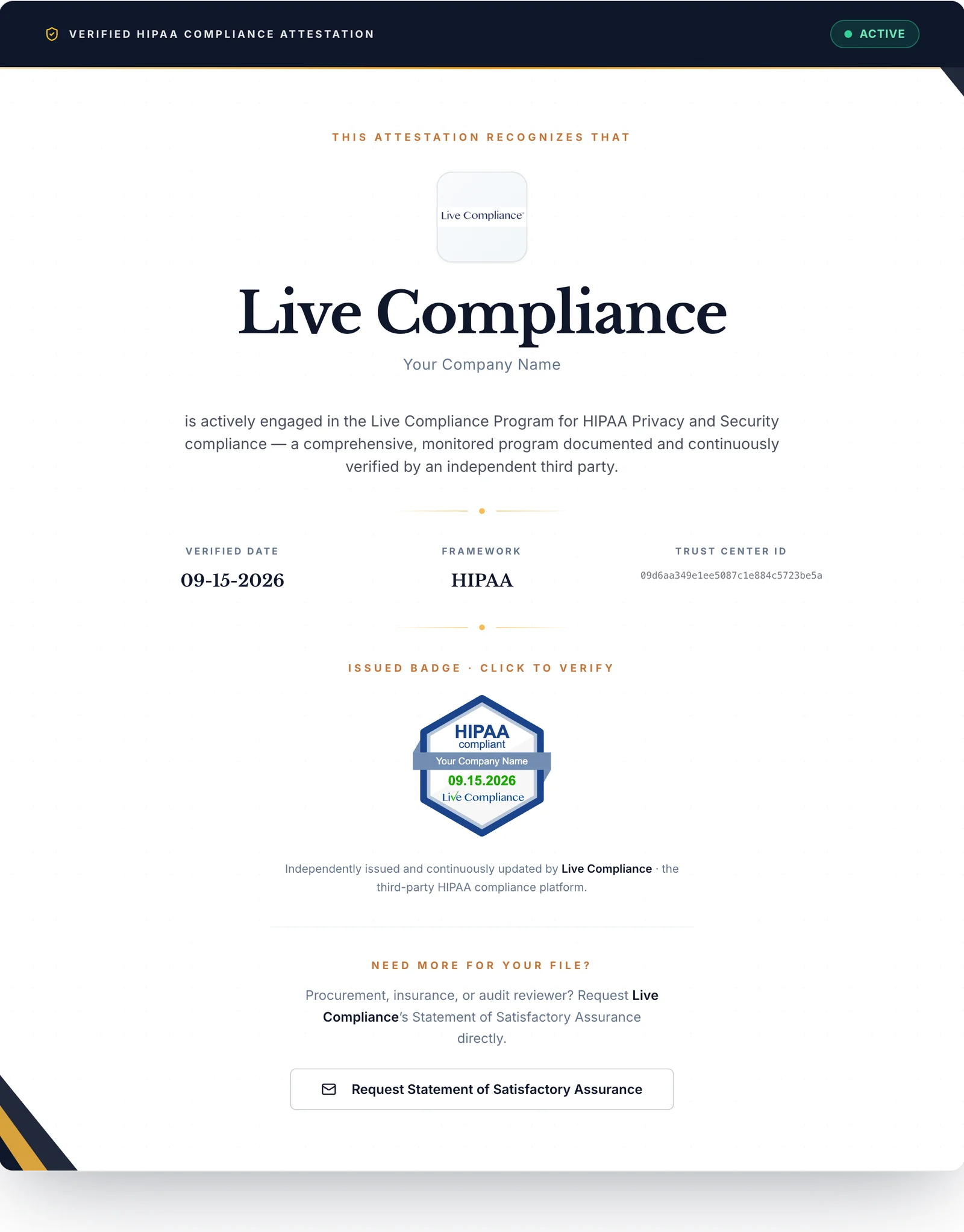
    The page the seal opens, on our domain.

    Your name and domain, the monitoring date, the framework, and your Trust Center ID, then the six areas the program covers and a button to request your Statement. Procurement, insurers, and auditors read it without a login and without calling you.

    What you see in your platform

    • Every click on your seal, counted
    • Every Statement request, counted
    Open the live page
    The lower half of the Trust Center page: the issued seal, the line saying it is independently issued and continuously updated by Live Compliance, and the button to request the Statement of Satisfactory Assurance.

    Procurement asks here

    03 / 03

    The problemEvery questionnaire asks the same questions, and the answers are scattered across the office.

    File.

    The Statement and the certificate, for the people who ask.

    Four pages, cited to the CFR, covering your designated security contact, workforce training, risk analysis, business associate agreements, incident response, and core policies, with an authenticity token on every page and a valid-through date. Reissued each year, beside the printed certificate that arrives in the mail.

    Reissued each year, with the risk analysis refresh

    Statement of Satisfactory Assurance

    Four pages. What it covers, in order.

    1. 01Designated security contact
    2. 02Workforce training
    3. 03Risk analysis
    4. 04Business associate agreements
    5. 05Incident response
    6. 06Core policies and procedures
    Cited to
    45 CFR §§ 164.308, 164.312, 164.502, 164.504
    On every page
    An authenticity tracking token
    Valid through
    One year from issue, then reissued

    Certificate of HIPAA Compliance

    Printed, dated, and signed, with a QR code anyone holding it can check. Mailed to your office every year.

    Reissued every year

    Where it earns its keep

    Six places the question comes up, answered before it is asked.

    Most organizations answer the same compliance questions every quarter in a different format. The seal and the Statement answer them once.

    1. 01

      Hospital RFPs and compliance questionnaires

      A hospital's questionnaire asks for the same evidence every time. Send the Statement and the seal with the bid, before procurement asks.

    2. 02

      Cyber liability insurance applications

      Applications and renewals ask about workforce training, risk analysis, and incident response every year. The Statement answers them in one document.

    3. 03

      Vendor questionnaires from referring partners

      Healthcare organizations now demand satisfactory assurance from their IT, billing, and revenue cycle partners. Show it before you are asked.

    4. 04

      Patients, on your website

      A patient who clicks the seal lands on a page bearing your name, your domain, and the date your program was last monitored.

    5. 05

      Auditor evidence packets

      When OCR, a state regulator, or a CPA firm arrives, the Statement, with its CFR citations, designated security contact, and authenticity token, is page one of the packet.

    6. 06

      The waiting room

      The printed certificate arrives in the mail every year, dated and signed, for the front desk, the lobby, or the back office.

    A client filling out a cyber liability application used the Statement to check off the controls already in place. A multi-hour back-and-forth with the broker became a fifteen-minute review.
    Real client · an insurance renewal

    How you earn it

    The seal follows the work.

    It goes live when the program is running and reads inactive when it is not. It does not replace the work. It documents it.

    1. Activate the service

      Your engagement begins, your workspace is set up, and your named compliance team is assigned.

    2. Load the workforce

      Add your employees and assign their HIPAA training and policy acknowledgements.

    3. Start the risk analysis

      Begin the security risk analysis inside the platform. The work itself becomes the evidence.

    4. The seal goes live

      The seal, your Trust Center page, the Statement, and the certificate are issued, and stay current as long as the program is active.

    Plainly

    HHS does not certify HIPAA compliance, and neither do we.

    The seal, the Statement, and the certificate are third-party documentation that your organization runs a monitored compliance program. That is what procurement, insurers, and auditors ask to see, and it is what they get.

    OSHA and NIST seals follow the same model, as separate engagements

    In the price

    Not an add-on. On every plan.

    Some platforms sell the trust center as a separate product. Here the HIPAA Seal of Compliance, your Trust Center page, the Statement of Satisfactory Assurance, and the printed certificate come with Essentials, Professional, and Enterprise alike, plus $8.33 per employee per month, billed annually, and no add-on fees. OSHA and NIST seals follow the same model as separate engagements.

    See the plans
    Essentials
    $399a month
    Single-location practices and business associates
    Professional
    $895a month
    Organizations that want the security layer built in
    Enterprise
    $1,450a month
    Multi-location practices and health systems

    Straight answers

    The Seal of Compliance, in plain words.

    The Live Compliance Seal of Compliance is a live HIPAA badge for your website that opens a dated verification page on livecompliance.com, your Trust Center, backed by a Statement of Satisfactory Assurance and a printed Certificate of HIPAA Compliance. It is included on every plan.

    It reads from the same program record your compliance team works in, so it says what the record says and nothing more.

    • Every plan
    • Updated live
    • Reissued yearly
    • Since 2010
    • 100% audit success rate

    No. HHS does not certify HIPAA compliance, and a vendor who says they certify you is misdescribing the law. The Seal of Compliance, the Statement of Satisfactory Assurance, and the certificate are third-party documentation that your organization is actively engaged in a monitored compliance program: service active, workforce loaded, risk analysis under way, policies in place. That is what procurement, insurers, and auditors ask to see.

    Live Compliance issues it, based on your active engagement with the platform: the service is active, your workforce is loaded, your risk analysis is in progress, and your policies are in place. The seal reads from the same program record your compliance team works in, so it cannot say more than the record does.

    Your Trust Center page reflects your current status. If the engagement lapses or the program goes inactive, the seal no longer shows active. That is the point. The signal has to be honest to be useful.

    We give you one line of embed code, a single script tag, that you paste into your site's footer. The seal renders on its own and updates in real time. Most clients have it live the same afternoon. In email signatures and proposals, link to your Trust Center page instead.

    Yes. Every seal resolves to a unique page on livecompliance.com bearing your organization's name, domain, last monitoring date, and Trust Center ID. The Statement carries an authenticity tracking token on every page and the certificate a QR code, so anyone holding a copy can check it against the record.

    The Statement carries a valid-through date, typically one year from issue, so it cycles with your annual risk analysis refresh. The certificate is dated the same way and mailed to your office each year.

    Yes, and many clients do. It covers most of what carriers ask about workforce training, risk analysis, incident response, and vendor management, so it goes into the renewal packet as one document instead of a questionnaire answered from memory.

    Yes. Your platform counts every click on your seal and every request for your Statement, so you know how often buyers, patients, and auditors are looking, and when a bid is being checked.

    Show them, instead of telling them.

    Talk to a specialist about the seal, the Statement, and the plan they come with. Then, if you want it, the guarantee: audit-ready in 60 days, or we keep working at no additional cost until you are.

    Talk to a Specialist

    30 minutes · One specialist · No obligation

    500+
    healthcare organizations
    100%
    audit success rate
    2010
    protecting healthcare since